How to Use AI Without Losing Fairness or Control
by Talent Team on December 5, 2025
The use of artificial intelligence (AI) in recruitment has grown rapidly. AI is now employed for everything from automating CV screening and matching candidates to jobs, to chatbots answering candidate questions, and even analyzing video interviews. For a small company, AI technology might sound futuristic, but it can bring tangible benefits—if used correctly. At the same time, there are risks associated with AI, particularly around fairness and transparency, that need to be managed carefully. Here we summarize the opportunities and pitfalls of AI in the hiring process, and how ZenZaii leverages AI in a responsible way.
Opportunities with AI in Recruitment
Efficiency and speed
AI is unbeatable when it comes to swiftly handling large volumes of data. An AI-driven system can scan hundreds of applications in a fraction of the time it would take a human, flagging candidates whose profiles match the job requirements. AI can also detect patterns and insights—for example, identifying which experiences correlate with success in a role—by analyzing historical data. The result is a smoother, faster recruitment where administrative tasks are minimized. Research by the EU has noted that AI can improve productivity in work processes by quickly breaking down information and providing decision support. In practical terms, AI can dramatically shorten your time-to-hire by automating the initial filtering and giving you data-driven recommendations.
More objective decisions (in the best case)
One hope for AI is that it can reduce human error and bias. If an AI is trained to focus only on job-relevant merits—say, ranking candidates based on test scores or specific skills—it can ignore irrelevant factors that might sway human judgment. In practice, some AI tools are used to anonymize candidate data or to score applicants using standardized criteria, which can lead to more consistent and impartial selections. The International Labour Organization (ILO) has noted that AI has the potential to counter unconscious bias in hiring, provided the systems are well-designed and only consider job-related criteria. Companies that get this right can gain a competitive edge by tapping into a broader talent pool in an unbiased way.
Better candidate experience
AI in the form of chatbots or intelligent FAQs can give candidates quick information 24/7—whether it’s about the company, the role, or their application status. This can boost engagement and reduce uncertainty. AI scheduling assistants can help find convenient interview times without endless email chains, making the process more accommodating. All together, the technology can make the hiring process more candidate-friendly and responsive, especially helpful when your team has limited time. Candidates appreciate prompt answers and smooth coordination, which AI can facilitate behind the scenes.
Risks and Challenges with AI in Recruitment
Risk of bias and discrimination
AI is not immune to bias—it learns from the data we feed it. If historical hiring data reflects biases (for example, if a certain group was hired more often than another), an AI can easily replicate or even amplify those patterns. The European Parliament has warned that even if an algorithm’s stated aim is to increase fairness, skewed training data can cause AI to entrench systemic discrimination in recruitment. There have been real-life examples: some AI résumé screeners were found to downgrade candidates simply for having certain keywords. One study, for instance, discovered that an AI screening tool gave lower scores to CVs that mentioned involvement in a disability advocacy group, compared to identical CVs without that info – a clear case of built-in bias. Such issues underscore that without careful design and monitoring, AI can inadvertently perpetuate the very biases we want it to eliminate.
Lack of transparency and explainability
Many AI models (especially complex machine learning algorithms) are “black boxes” – it’s not always clear why the AI selected one candidate or rejected another. This opacity is problematic both ethically and legally. Both candidates and employers might find it hard to trust a decision that can’t be explained. Emerging regulations, like the EU’s upcoming AI Act, focus heavily on the need for AI systems to be transparent, explainable, and free from discrimination in high-risk areas such as recruitment. Companies will likely be required to justify how their AI makes decisions, meaning if you use AI in hiring, you need to ensure you can trace its logic and prove it’s fair.
Incorrect conclusions and new biases
AI is great at generalizing from data, but it can sometimes misfire on individual cases. If a tool, for example, analyzes video interviews for “enthusiasm” by tracking eye contact or voice tone, it might unfairly score certain candidates lower – say, those who are neurodivergent, have a disability affecting eye contact, or come from a culture with different norms of communication. Without human oversight, AI could introduce new kinds of barriers for these groups. There’s also the risk of over-relying on what the AI deems important, which might cause you to overlook valuable non-traditional candidates. In short, if not used carefully, AI can create false negatives/positives and raise equity concerns.
ZenZaii’s Use of AI – Augmentation with Humans in Control
At ZenZaii, we see AI as a powerful tool to simplify and improve recruitment, but we are very aware of the risks. That’s why we’ve chosen a human-centered AI strategy:
“Ask Zen” – an intelligent assistant
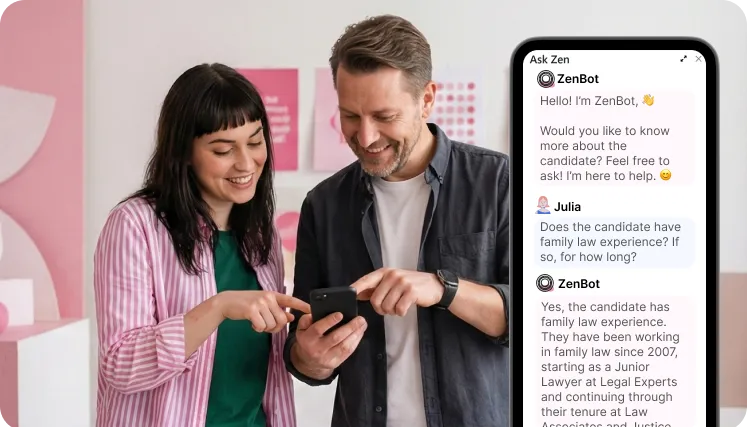
One of ZenZaii’s unique features is Ask Zen, an AI-driven assistant that can help recruiters and managers with common tasks and questions. For example, Ask Zen can suggest interview questions tailored to a given job profile, or help draft a job ad that is inclusive in tone. The key difference between this and letting AI automatically reject candidates is that Ask Zen provides supportive recommendations, while the final decisions remain with the human user. In this way, we leverage AI’s strengths (fast analysis, knowledge drawn from large datasets) without handing over control of critical hiring decisions. The AI becomes your helper, not the decider.
Bias checks and balances
We continuously test our algorithms for bias. For instance, we run simulations on our matching and ranking functions to detect if certain groups might be unintentionally disadvantaged. If we ever find such a pattern, we adjust the algorithm and add any needed criteria to ensure fairness. The goal is for AI features in ZenZaii to reduce human bias – not introduce new ones. We know this is an ongoing responsibility, so our development team keeps fairness as a top priority whenever we enhance our AI capabilities.
Transparency and user control
In ZenZaii, the user gets insight into how AI suggestions are generated. If our matching engine suggests five top candidates for a role, the recruiter can see which requirements or keywords factored into that recommendation. We avoid “black box” scenarios. Moreover, all AI-driven features are optional. We believe in providing tools, not taking over the process. As the employer, you retain full oversight and can tweak search criteria or override AI suggestions at any time. ZenZaii’s AI is there to assist and inform you, but you always make the final call.
In summary, ZenZaii embraces the advantages AI offers – speed, scale, data-driven insight – but we build in safeguards so the technology is used responsibly. By combining AI with human judgment, our users get the best of both worlds: an efficient recruitment process that remains personal, fair, and transparent. AI is here to stay in the recruiting world, and with ZenZaii even small companies can benefit from its possibilities in a safe and effective way.
References
- International Labour Organization (ILO) commentary on AI in recruitment (referenced in internal notes).
- EU research on AI productivity and decision support (referenced in internal notes).
- Example study showing algorithmic bias in résumé screening (referenced via ILO and academic literature).
- Best practices for reducing bias in interviews (PMC): https://pmc.ncbi.nlm.nih.gov/articles/PMC9553626/
- Blind orchestra auditions better for women: https://www.princeton.edu/news/2000/11/28/blind-orchestra-auditions-better-women-study-finds
Tagged: AI in recruitmentartificial intelligence hiringethical AI recruitmentrecruitment automationAI hiring toolsresponsible AI HRAI assisted recruitment